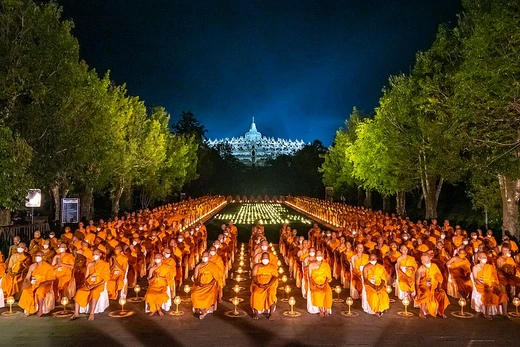
Samsara
Cyclic existence of birth, death, and rebirth in Indian traditions.

Saṃsāra (Devanagari: संसार) is a Sanskrit word meaning "wandering" as well as "world," connoting cyclic change or, less formally, "running around in circles." In Indian religions and philosophies, it is the concept of all beings experiencing an ongoing cycle of life, death, and rebirth, broadly equated with transmigration, reincarnation, the karmic cycle, or a cycle of aimless drifting. The cyclicity of all life, matter, and existence is a fundamental belief of most Indian religions, with roots in post-Vedic literature and developed form in early Upanishads, Buddhism, Jainism, and various schools of Hindu philosophy.
- field
- Indian religions and philosophies
- known_for
- Concept of cyclic life, death, and rebirth; linked to karma theory
- related_terms
- Moksha, Nirvāṇa, Mukti, Kaivalya
- etymology
- From Sanskrit saṃsṛ, meaning 'to go round, revolve, pass through a succession of states'
Lore & Background
Saṃsāra is derived from the verbal root sṛ with the prefix saṃ, meaning "to go round, revolve, pass through a succession of states." The term is related to Saṃsṛti, referring to the "course of mundane existence, transmigration, flow, circuit or stream." The concept developed in post-Vedic times, traceable in Samhita layers of the Rigveda, but fully develops in early Upanishads such as the Katha, Shvetashvatara, and Maitri Upanishads. The earliest Vedic texts incorporate ancestor worship and afterlife in heaven or hell based on merit, but later texts introduced the idea of returning and being reborn when merit runs out, leading to the cycle of life, death, rebirth, and redeath. The detailed doctrines of saṃsāra flowered with unique characteristics starting around the mid 1st millennium BCE in Buddhism, Jainism, and Hindu philosophy. The Sramanas traditions (Buddhism and Jainism) emphasized human suffering, placing rebirth, redeath, and truth of pain at the center. They view saṃsāra as a beginningless cyclical process with each birth and death as punctuations, and spiritual liberation as freedom from rebirth and redeath. Hindu traditions accepted Ātman or Self as unchanging essence, while Buddhist traditions denied such a soul and developed Anattā.
Reader's Guide
Saṃsāra is a foundational concept across Indian religions, tying together karma theory and the spiritual quest for liberation. Its significance lies in providing a framework for understanding existence as a cycle of birth, death, and rebirth, from which liberation—called Moksha, Nirvāṇa, Mukti, or Kaivalya—is the ultimate goal. The concept evolved from earlier Vedic ideas of afterlife and redeath (Punarmṛtyu) into a comprehensive doctrine shared by Hinduism, Buddhism, and Jainism, though each tradition developed distinct soteriological paths. The historical origins are obscure, with evidence suggesting parallel development and mutual influences among traditions. Saṃsāra remains central to the internal disagreements and spiritual practices of Indian traditions, emphasizing the rare opportunity of human rebirth to break the sequence and attain release. Its legacy endures as a key philosophical and religious concept that shapes views on life, death, and the nature of reality.
Did You Know?
- Saṃsāra literally means 'wandering' or 'running around in circles'.
- The concept is not discussed in the Vedas themselves but appears in developed form in early Upanishads.
- Liberation from saṃsāra is called Moksha, Nirvāṇa, Mukti, or Kaivalya.
- The term is related to Saṃsṛti, meaning 'course of mundane existence, transmigration, flow, circuit or stream'.
More in Hindu And Buddhist Terms 1-18
Spotted an error? Know more?
This is a living reference — every entry is fact-audited, and reader corrections feed straight into our audit queue. Suggest an edit · See this site's audit record