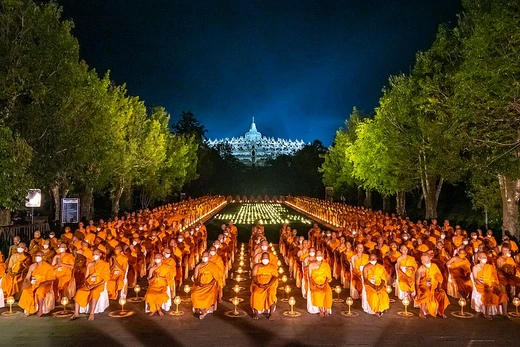
Nirvana
Concept of liberation from suffering and rebirth in Indian religions.

Nirvana, in the Indian religions (Jainism, Hinduism, Buddhism, and Sikhism), is the concept of an individual's passions being extinguished as the ultimate state of salvation, release, or liberation from suffering (duḥkha) and from the cycle of birth and rebirth (saṃsāra). It is sometimes used as a synonym of moksha and mukti, and all Indian religions assert it to be a state of perfect quietude, freedom, and highest happiness.
- field
- Indian religions (Jainism, Hinduism, Buddhism, Sikhism)
- known_for
- Concept of liberation from suffering and rebirth; extinguishing of passions
- etymology
- From Sanskrit nis+vāna, meaning 'blown out, extinguished'
Lore & Background
The term nirvana appears in texts of all major Indian religions, though its earliest use in a soteriological sense is attributed to Buddhism. The word derives from the verbal root vā 'blow' with the preverb nis meaning 'out', thus 'blown out, extinguished'. In Buddhist tradition, nirvana is described as the extinguishing of the three fires or poisons: greed, aversion, and ignorance, which cause rebirths and suffering. The Buddha is believed to have realized two types: sopadhishesa-nirvana (with remainder) at awakening, and parinirvana (without remainder) at death.
Reader's Guide
Nirvana is a central soteriological goal across Indian religions, though described differently. In Hinduism, it is often equated with moksha, the union or realization of identity of Atman with Brahman. In Jainism, it represents the release of a soul from karmic bondage and samsara. Buddhism describes nirvana as the abandonment of the ten fetters, marking the end of rebirth by stilling the 'fires' that keep the process going. The concept is most commonly associated with Buddhism, though some writers believe it was adopted by other Indian religions after becoming established in Buddhism, with different meanings. The earliest attestation of the term nirvana in Buddhist texts is attributed to the Nikayas of the Sutta Pitaka, though the historicity of the First Buddhist Council has been questioned by several historians. In Buddhist tradition, nirvana is also described as identical to anatta (non-self) and sunyata (emptiness), while in Theravada Buddhism it is seen as the only unconditioned existent.
Did You Know?
- The word nirvana is from the verbal root vā 'blow' with preverb nis meaning 'out', so its original meaning is 'blown out, extinguished'.
- The Buddha is believed to have realized two types of nirvana: one at awakening and another at his death.
- In Buddhist tradition, nirvana is described as the extinguishing of the three fires: greed, aversion, and ignorance.
- The earliest attestation of the term nirvana in Buddhist texts is attributed to the Nikayas of the Sutta Pitaka, though the historicity of the First Buddhist Council has been questioned.
Frequently Asked Questions
What is Nirvana in simple terms?
Nirvana refers to the complete extinguishing of desire, craving, and suffering, representing the ultimate liberation from the endless cycle of being born, dying, and being born again. It is regarded as the highest state of peace and freedom one can attain within Indian spiritual traditions.
Where does the word Nirvana come from?
The term derives from the Sanskrit root combining 'nis' and 'vāna,' which literally translates to 'blown out' or 'extinguished,' evoking the image of a flame being put out. This metaphor captures the idea that the fires of passion and attachment are finally doused.
Is Nirvana the same thing as Moksha?
In many contexts, yes—Nirvana, Moksha, and Mukti are often used interchangeably to describe the soul's final release from saṃsāra. However, Nirvana carries a stronger emphasis on the active 'blowing out' of mental defilements, while Moksha leans more toward the passive sense of being set free.
Which religions include Nirvana in their teachings?
The concept appears across several Indian faiths, including Buddhism, Hinduism, Jainism, and Sikhism. Each tradition frames it slightly differently, but all agree it represents the ultimate end of suffering and the cessation of rebirth.
What does achieving Nirvana actually look like?
It is described as a state of perfect stillness, total freedom from mental agitation, and the deepest possible happiness. Rather than being a physical place, it is understood as an inner condition where all craving and attachment have been fully dissolved.
More in Hindu And Buddhist Terms 1-18
Spotted an error? Know more?
This is a living reference — every entry is fact-audited, and reader corrections feed straight into our audit queue. Suggest an edit · See this site's audit record